Donate
Priority: Communities

Invest in Communities First
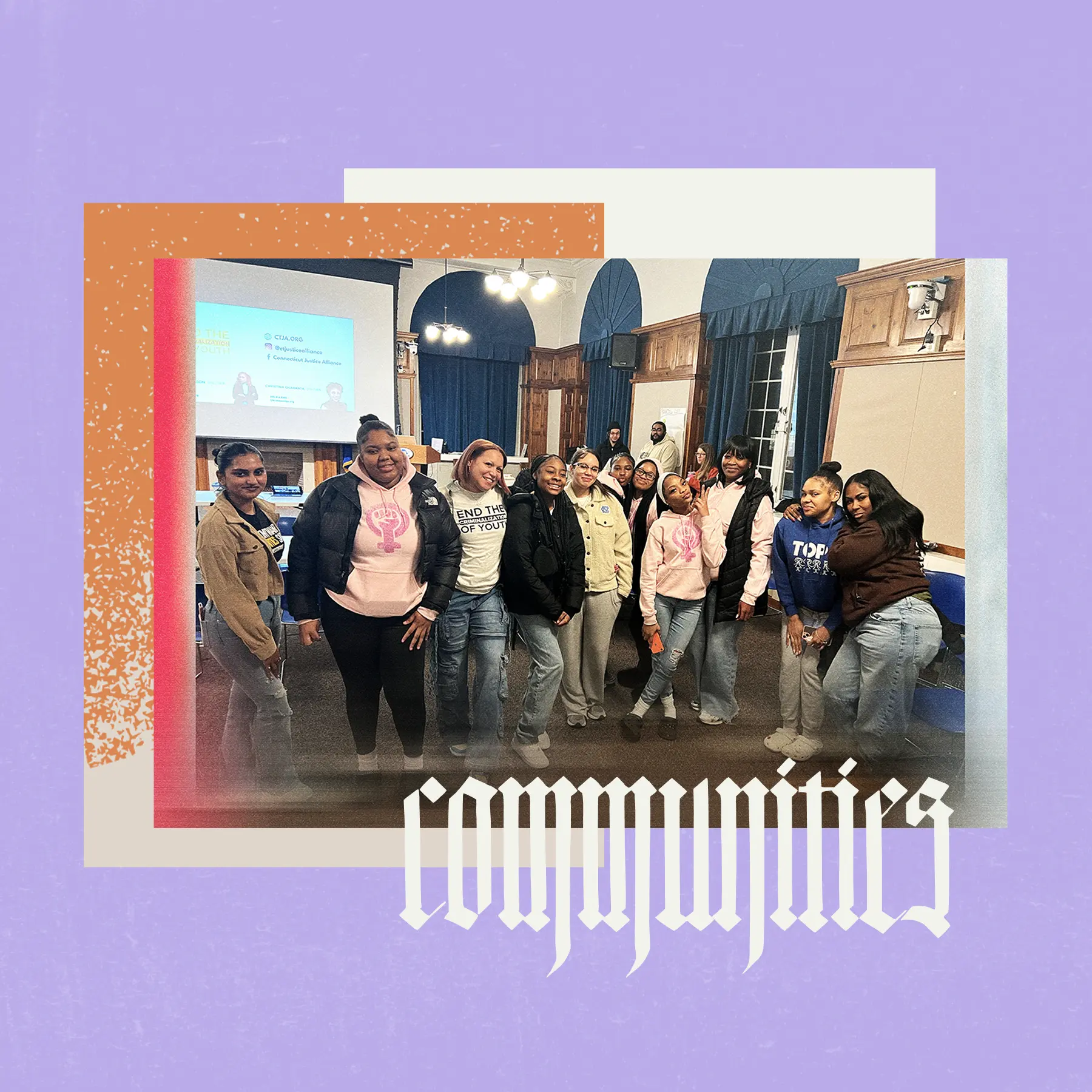

Youth involvement in Connecticut’s legal system is not random. It stems from unmet needs in housing, education, mental health, economic stability, and community safety. To divert young people away from the legal system, CTJA is pushing the state to invest in those needs, within our communities.

P1_Invest in Communities
Data
119,000

Connecticut youth between the ages of 14 and 26 are disconnected from education and employment

92%

Of cases successfully mediated by Catalyst CT (Bridgeport) in 2023-24

7

Number of states with restorative justice programs, including CT

Background

More than 100,000 young people in Connecticut are at risk of disconnection from education and employment, or already are.

Young people do not fall into Connecticut’s legal system by chance. They are pulled in by the gaps in housing, mental health care, schools, family support, and community safety.

Connecticut is investing in the wrong end of the problem. Instead of pursuing a truly diversion-first strategy, the state continues to fund facilities that hold young people after they have been failed, while underfunding the supports that would have kept them engaged and out of the system in the first place. 

System involvement disrupts education, employment, and long-term earning potential. Research shows that youth interaction with the legal system increases the likelihood of future arrests. Community-based programs reduce it.

Investment in community-based programming benefits everyone, because it leads to better, safer outcomes not just for some young people, but for all young people in a community, as well as their families and neighborhoods. 

We are pushing Connecticut to redirect resources from facilities that harm to programs that work: public schools, mental and behavioral health care, stable housing, family supports, afterschool programs, mentoring, violence prevention, and the credible messengers already doing this work.

Many of these supports already exist. They just require funding at the scale of the need.

Here’s how we move Connecticut forward.

Solutions

Make community-based responses the default

Make community-based responses the default

Arrest, court involvement, and confinement should not be the automatic response when a young person makes a mistake. Alternatives to incarceration include Juvenile Review Boards, Youth Diversion Teams, restorative justice practices, and credible messenger mentoring, among others. These alternatives help young people take responsibility, repair harm, and connect with services without being pushed into the legal system.

Fund mental & behavioral health care in every community

Fund mental & behavioral health care in every community

Many young people who enter the legal system needed mental and behavioral health care long before they came to the attention of law enforcement. Mental health support can’t be something young people first have access to in custody. The state must fund community-based services across Connecticut to meet the needs of our kids.

Strengthen schools & keep kids in them

Strengthen schools & keep kids in them

Public schools are where young people spend most of their time and where many are first pulled into the legal system. Connecticut should fully fund its schools and replace exclusionary discipline with trauma-informed, restorative, and culturally responsive practices that keep young people in the classroom. 

Stabilize families with housing & economic support

Stabilize families with housing & economic support

Many young people who enter the legal system come from families facing housing instability, economic stress, or both. Connecticut should treat family stability as a core public safety strategy. We need stronger housing supports, family assistance programs, reliable health care, and policies that reduce the stressors that pull young people toward danger.

Build real community safety

Build real community safety

Real community safety is not built in courtrooms or locked facilities. It is built through afterschool programs, mentoring relationships, youth development work, and violence intervention led by people who know their communities.

Learn from & invest in what works

Learn from & invest in what works

Catalyst CT’s restorative justice work & CJR’s Waterbury Credible Messenger program show what transformative justice and accountability over punishment look like in practice. These supports are more effective and more cost-efficient. CTJA is pushing to expand responses like these so they become the standard in every instance. 

Future funding decisions should follow the evidence and leadership of the communities most affected, especially historically disinvested communities, youth, and communities of color.

Here’s how we got here.

Key moments in the history of youth justice in CT, to highlight the progress we’ve made making our state safer for everyone — and the distance we have left to go. Credit to Justice Policy Institute for key info.

Timeline
1993

The Connecticut Civil Liberties Union filed a class-action lawsuit named for its lead plaintiff, Emily J., revealing that CT’s youth detention facilities were overcrowded, neglectful, unsafe, and overly punitive 

1995-2000

Youth incarceration in the U.S. hit a peak; in CT 680 young people were locked up in 2000

1997

The Emily J. Consent Decree passed, requiring the state to improve conditions at youth detention facilities

2001

CT Gov. John Rowland opened the Connecticut Juvenile Training School, modeled on a max security adult prison in Ohio

2009

CT began to invest in evidence-based, family-focused adolescent treatment programs

2009

School-Based Diversion Initiative began educating teachers on restorative practices & impact of trauma & behavioral health challenges

2011

CT recorded a drop of 70% in youth confinement

2018

The Connecticut Juvenile Training School closed for good, thanks in part to the work of CTJA & allies

2020

CT youth admissions to juvenile detention dropped 63% from 2006 

2026

Despite improvements, glaring inequalities remain, specifically as it relates to youth of color

newsletter-new

Stay Connected

Subscribe to our newsletter to receive updates on youth justice in CT.


      Tape Next Page Launch
      Next up

      We’re prioritizing CT’s kids